
Pressure Gauges and Pressure Transmitters
Home
Products > Pressure Gauges and Pressure Transmitters
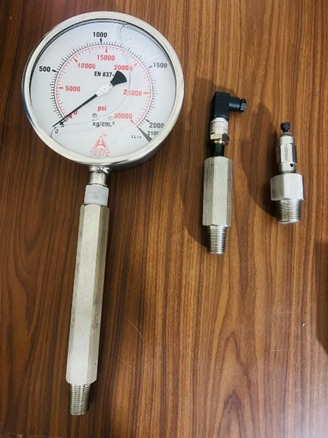
Pressure Gauges and Pressure Transmitters:
⚙️ Pressure Gauge
Overview
- A pressure gauge is a mechanical device that provides a direct, local indication of pressure in a system.
- It typically uses a Bourdon tube, diaphragm, or capsule mechanism to convert pressure into needle movement on a dial.
- In HMS test wells, gauges are typically mounted for local operators to quickly check pressure, while transmitters are integrated into the control room software for continuous monitoring, logging, and safety automation.
Key Features
- Analog display (dial with pointer).
- Range: Commonly from vacuum up to 20,000 psi (special gauges can go higher).
- Accuracy: ±0.5% to ±2% of full scale.
- Construction: Stainless steel case, safety glass dial, and pressure connection (NPT, BSP, or flanged).
- Operation: No external power required.
Applications
- Local monitoring of hydraulic systems.
- Oil & gas wellheads and test wells.
- Compressors, pumps, and pipelines.
- Safety monitoring in boilers and pressure vessels.
📡 Pressure Transmitter
Overview
- A pressure transmitter is an electronic device that converts pressure into a standard electrical signal (e.g., 4–20 mA, HART, or digital protocols).
- It allows remote monitoring, control, and automation.
Key Features
- Sensing element: Strain gauge, piezoelectric, or capacitive sensor.
- Output signal: Analog (4–20 mA) or digital (Modbus, HART, Profibus).
- Accuracy: ±0.1% to ±0.25% of full scale (higher than gauges).
- Range: From vacuum up to 100,000 psi depending on design.
- Construction: Stainless steel housing, explosion-proof or intrinsically safe options for hazardous areas.
- Requires power supply (typically 24 VDC).
Applications
- Integration with SCADA/DCS systems for oil & gas fields.
- Automated test wells and booster systems.
- Pipeline monitoring and leak detection.
- Aerospace and industrial process control.